The noted Canadian illustrator and wood engraver Wesley Bates (b. 1952) produced the engravings for an edition of poems by the somewhat obscure 3rd- or 4th-century CE Greek epigrammatist Rufinus, translated by the Canadian writer and scholar Robin Skelton and printed in British Columbia at the Barbarian Press in an edition of 200 copies in 1997. Little is known about Rufinus himself, but Skelton informs us that the works of Rufinus combine sensuality with wit and show an appreciation for female beauty. Many of the poems are explicit in nature, and often have misogynistic undertones. Each poem is translated into rhymed metrical verse, demonstrating Skelton’s appreciation for past traditions of translating Latin and Greek in the 18th and 19th centuries.
Wesley Bates was born in the Yukon in 1952 and raised in South Western Saskatchewan. After studying painting and printmaking at Mount Allison University in Sackville, New Brunswick from 1972-1977, he pursued a career as a painter and printmaker in Sackville, and turned to illustration and wood engraving 1981. He has since been a much sought-after illustrator by numerous publications and publishers.
The engravings were printed directly from the blocks on Zerkall White Wove and Zerkall Cream Laid papers, with the book designed, bound, and the text handset in Jan Van Krimpen’s Van Dijk type, with his Cancelleresca Bastarda and Open Kapilalen for display, by Barbarian Press proprietor Crispin Elsted. Elsted’s wife and Barbarian Press co-founder Jan Elsted printed the book. Our copy is signed by Robin Skelton and the Elsteds and is another gift from our friend Jerry Buff.
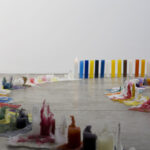
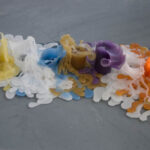
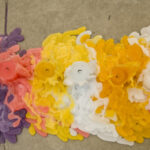
Spencer Finch – 366, Emily Dickinson’s Miraculous Year (2009)
This work is based on Emily Dickinson in 1862, when she wrote 366 poems in 365 days. It is a real-time memorial to that year, which burns for exactly one year. The sculpture is comprised of 366 individual candles arranged in a linear sequence, each of which burns for 24 hours. The colour of each candle matches a colour mentioned in the corresponding poem. For the poems in which no colour is mentioned, the candles are made out of natural paraffin.